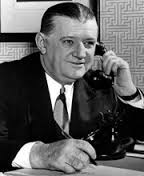
"On Any Given Sunday" . . . The Bert Bell Story.
Return to TedSilary.com Home Page
This recap, compiled by alumnus Kevin
Burke, appeared in The Haverford
School's football program for the 2013 season. One hundred years earlier,
Bert Bell was the Fords' captain and he went on to become just a
liiiiiitle bit
famous (smile).
“ON ANY GIVEN SUNDAY…”
A Short History of The Man Behind The Modern NFL -
Bert Bell
, Class of 1914: Haverford School Three Sport Captain, Hall of Fame Inductee and NFL Commissioner
Name: de Benneville “Bert” Bell
Born: Sunday, February 25, 1895
Died: Sunday, October 11, 1959
Occupations: NFL Team President, Coach and Early Owner of Philadelphia Eagles
and Pittsburgh Steelers.
4th NFL Commissioner: 1946-1959
Inducted into NFL Hall of Fame: 1963
Inducted into Haverford School HOF: 2010
Introduction
Art Rooney, George Halas, Charles Bidwell, Tim Mara, and Marshall are the names that laid the foundation for what we now know as The National Football League. But Bert Bell is the name that laid the foundation for these men to come together to form the brain trust of the NFL. Bert Bell, native Philadelphian, 1916 quarterback for the Penn Quakers who made the only trip in the school’s history to the Rose Bowl - and the fourth commissioner of the National Football League - established the foundation of the modern NFL in his hometown of Narberth, Pennsylvania. Bell is known by history and those who knew and loved him as the godfather of the National Football League. He established the groundwork for the merger between the All-America Football Conference, and then later on for the final merger between the American Football Conference and the National Football League. He had the vision in the mid 1950's to create opportunities for football to get national exposure through television, which inevitably changed the course of the game, laying the ground work for the sports media juggernauts we see on television today1.
Background
Bert Bell was born de Benneville Bell to a prominent Main
Line family of significant wealth and influence on February 25, 1895. For most
of his life, Bell was involved with football; the sport was in his blood. He
was, indeed, a football man from wire to wire. As a schoolboy, he went from
Episcopal Academy to the Delancey School, to Haverford School where he captained
the football, basketball and baseball teams as a senior.
There was never much question where Bell was going to
attend college. "Bert will go to Penn or he'll go to hell," his father was fond
of saying. Fulfilling his somewhat predetermined fate, Bell enrolled at Penn
1914. After a year of freshman ball and another on the "scrub" team, he became
the Quakers' varsity quarterback. Bell was a real firebrand and besides
quarterbacking he punted, returned punts, kicked field goals, and played
defense. In 1916, the cocky quarterback led Penn to the Rose Bowl.
In 1918, Bell served in France with the 20th General
Field Hospital, a mobile unit that had been formed at Penn. He was cited by the
United States and France for bravery at the mobile unit which, at times, was
under constant shelling by the Germans.
After the war, Bell returned home to captain the
Quakers for one final season in 1919, and then remained at Penn as an assistant
coach under John Heisman and Louis Young for nine years. He was credited with
developing the famous "hidden ball" play. Bell shifted to Temple as an assistant
coach for two seasons.
In 1933 Bert Bell and three former Penn teammates
bought the Frankford Yellowjackets of the NFL. Pro football was far from
big-time in 1933, however, Philadelphia sounded more big-time than Frankford, so
Bell moved the Yellowjackets to Philly and renamed them the Eagles in honor of
the symbol of Franklin Roosevelt's National Recovery Act. Bell became the coach,
business manager, publicist, ticket seller, while single-handedly kept the
Eagles afloat until 1940, when he joined Art Rooney as part owner of the
Steelers. In 1946 Bell sold his interest in the Steelers when he was named
commissioner of the NFL. Early in his ownership efforts he became an influential
owner, establishing the Draft system for first year players in 1935.
As Commissioner, he resided over the absorption of
three All-American Conference Clubs into a realigned NFL in 1950. Demonstrating
vision and integrity, Bell implemented home-game blackouts when television began
to become a factor in the 1950s. This allowed NFL teams to sellout the stadiums
without worrying people would want to stay home and watch the game on TV. He had
been hired by the owners but he stood up for the players, recognizing the
formation of the NFL Players Association when the owners refused. Bell would
constantly help players in landing loans, and off-season jobs, while giving each
player his home phone number telling them to call at any time.
"He had become a benevolent dictator, a man so powerful
that the magnates didn't dare oust him because he had become, too, a shining
symbol of pro football's integrity," wrote Arthur Daly in The New York Times in
1968. "Besides, they had developed so intense an admiration for the man and what
he had accomplished that they wanted him to keep running their show, a job he
was handling with consummate skill."
Bert Bell, who coined the statement "On any given
Sunday, any team can beat any other team," was keen on selling the game, trying
to get the sport on TV as much as possible, while selling its players to
commercials and billboard advertisements. Bell stood over the NFL as the sport
was beginning to make inroads to America's conciousness. One big moment came
during the 1958 NFL Championship game when the Baltimore Colts beat the Giants
in New York in the first overtime game in NFL history. A game that was also the
first telecast nationally. Following the game Bell stood back and watched the
celebration knowing the sport had arrived.
One of his peculiarities as commissioner was that,
despite the fact that he was entitled to his own box and free tickets, he always
paid for his tickets and sometimes liked to wander through the stadium,
cavorting with his pals, "the working stiffs," as he called them, in the cheap
seats.
That's one reason Bert Bell probably happened to be in
the end zone stands at Franklin Field in Philadelphia when he died. It happened
with two minutes left in a Steelers-Eagles game on October 11, 1959. Bell, the
64-year-old Commissioner of the National Football League, suffered a fatal heart
attack, proving once again that irony and destiny are not always strange
bedfellows2.
In 2012, The Bert Bell Memorial Football Conference celebrated its 50th anniversary. The Bert Bell league was founded, chartered and incorporated in 1962 in commemoration of the late great Bert Bell. The league was established to further the ideals of the game of football at the school level. Its general purpose is to strive to equip boys and girls with the mechanical skills, physical conditioning and mental attitude necessary for pursuit of the game at the high school and collegiate levels. Also, to teach through supervision and by example, the principles of sportsmanship and fair play without undo emphasis on winning or losin
g3.